

Why “CoCrucified”?
The title of this page was chosen intentionally. “CoCrucified” gets to the heart of Catholic education.

St. Paul claims to have been “crucified with Christ” in Galatians 2:20:
I have been crucified with Christ; it is no longer I who live, but Christ who lives in me…
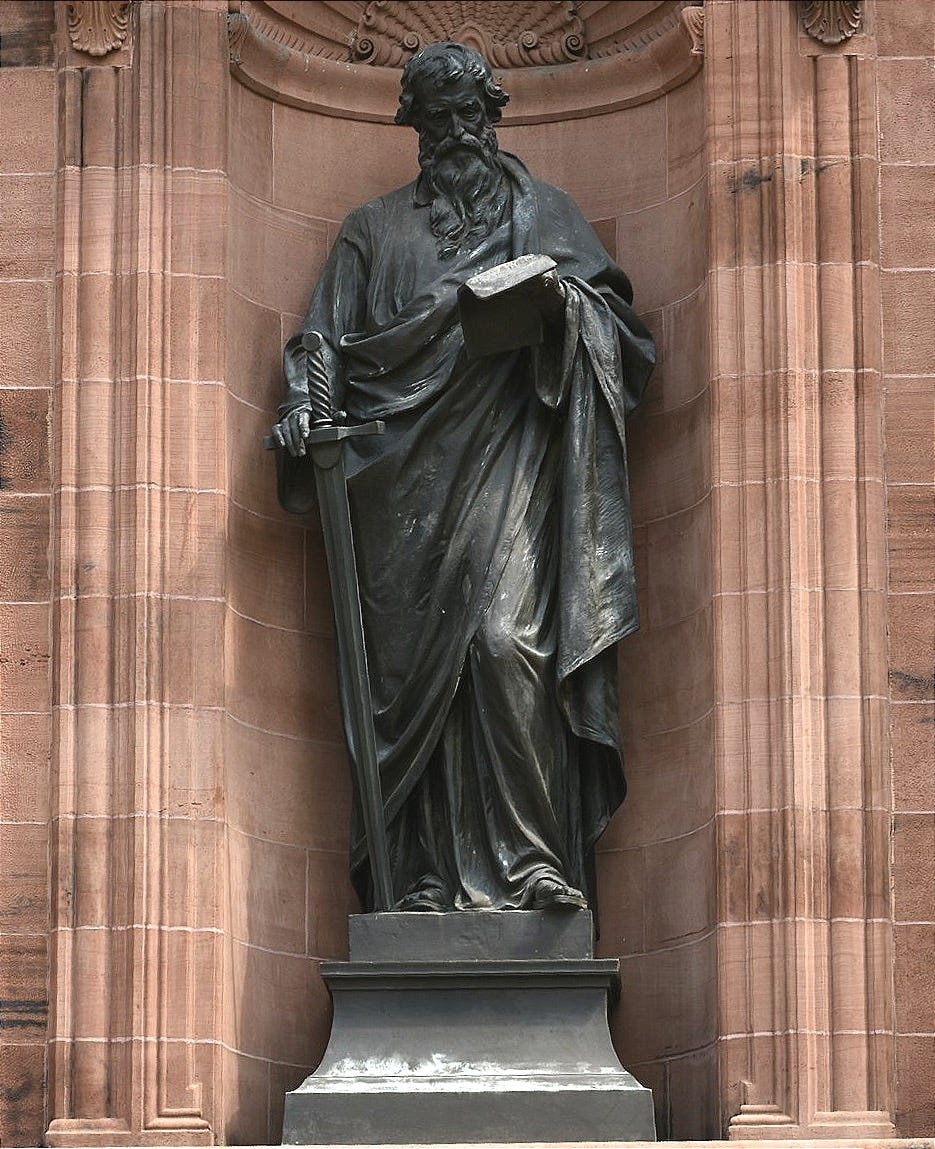
In the Greek, this is rendered “Χριστῷ συνεσταύρωμαι” (Christō sunestaúrōmai, “Christo confixus sum cruci” in the Latin Vulgate). That verb, συσταυρόω (sustauroō) is rendered by the BDAG as “to crucify together with, crucify with.”1 The result of this crucifixion with Christ is the indwelling of the risen Lord in the soul such that Paul disappears and Jesus lives through him. The implications of this statement are staggering. A few of them briefly:
The unification of the intellect with Christ’s so that Paul knows God with God’s own knowledge.
The unification of the will with Christ’s so that Paul loves God and neighbor with God’s own love—because of his reception of Christ’s love.
The subjection of Paul’s bodily passions to his divinely-ordered spiritual powers of intellect and will.
This co-crucifixion is effected in Paul by his sacramental life (cf. Romans 6:3-4)2 and life of prayer (Romans 8:15-26).3
Union in Christ’s death effects union in the body of Christ, both sacramentally and ecclesiologically.
In short, this one verb in Galatians 2 offers us a summary of the whole christian life, in both its goal and the means to attain that goal. Therefore, Catholics and Catholic educators ought to keep this verse close at hand. It is our mission statement for our own souls and the souls entrusted to us.
Being CoCrucified is our North Star. It is the animating reason for all that we do. It helps us to orient our educational goals and methods toward the proper ends:
The intellectual virtues of art, prudence, understanding, science, and wisdom promote the soul’s unity with Truth himself.
The theological virtues of faith, hope, and charity order the will to its final end.
The moral virtues put the passions under the rule of the reason and order our loves (ordo amoris).
These virtues also offer us interior dispositions that better facilitate a life of intimate prayer to the triune God and worthy sacrifice offered to him in the liturgy.
To be CoCrucified with Christ is to be part of the body of Christ. It is to be in union with the “pillar and bulwark of the truth” and united with the person that is himself Truth.
That’s the goal of this Substack. We’ll discuss important points about Theology (biblical, moral, spiritual, etc.), Philosophy (from the Aristotelean/Thomistic tradition, but in conversation with many others), Education (sources and strategies for becoming and helping others to become CoCrucified), and more.
William Arndt, Frederick W. Danker, Walter Bauer, and F. Wilbur Gingrich, A Greek-English Lexicon of the New Testament and Other Early Christian Literature (Chicago: University of Chicago Press, 2000), 978.
“Do you not know that all of us who have been baptized into Christ Jesus were baptized into his death? We were buried therefore with him by baptism into death, so that as Christ was raised from the dead by the glory of the Father, we too might walk in newness of life.” Romans 6:3-4
“For you did not receive the spirit of slavery to fall back into fear, but you have received the spirit of sonship. When we cry, “Abba! Father!” it is the Spirit himself bearing witness with our spirit that we are children of God, and if children, then heirs, heirs of God and fellow heirs with Christ, provided we suffer with him in order that we may also be glorified with him. …Likewise the Spirit helps us in our weakness; for we do not know how to pray as we ought, but the Spirit himself intercedes for us with sighs too deep for words.” Romans 8:15-26